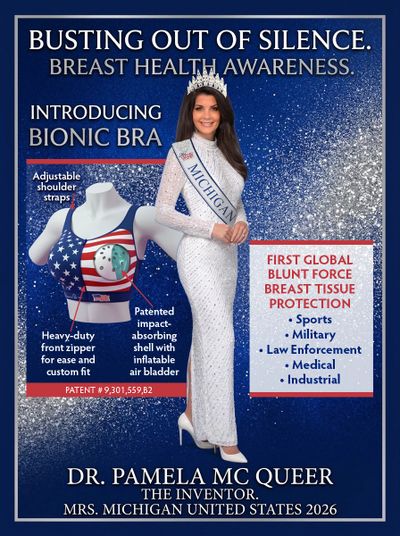
BUSTING OUT OF SILENCE CAMPAIGN

A global campaign calling athletes to come forward and report breast sports-related injuries.
Presented by: Dr. Pamela McQueer, ND, CHS, CHNP - Founder, Bionic Sports USA, The Bionic Movement™
BUSTING OUT OF SILENCE is a global awareness and advocacy campaign designed to encourage athletes to speak openly about breast sports-related injuries, pain, trauma, and long-term health concerns that too often go unreported. This campaign exists to help break the silence, reduce stigma, create stronger injury reporting, and build a future where female athletes at every level are protected, heard, and taken seriously.
Many athletes push through pain without reporting breast injuries because they fear embarrassment, being ignored, losing playing time, or being seen as weak. When these injuries are not reported, the damage is minimized, the athlete may not receive proper care, and valuable data is lost that could help improve prevention, education, and sports safety for future generations.
Speaking out is not complaining. Speaking out is leadership. Speaking out is protection for the next generation.

ABOUT THE FOUNDER
For more than 25 years, I have been working on the front lines of women’s sports safety, pushing for chest and breast protection that has been missing from sport for over a century. As a former competitive martial artist who personally experienced breast trauma, I saw firsthand how completely unprotected the female chest is in most sports and how little attention is paid to the long‑term consequences.
I am Dr. Pamela McQueer, ND, CHS, CHNP, founder and CEO of Bionic Sports USA and creator of The Bionic Movement. I am the inventor of the Bionic Bra, a first‑of‑its‑kind, patented air‑bladder chest protection device designed to disperse and mitigate impact to the breast, sternum, ribs and heart region. At a time when research shows that up to half of female athletes experience contact breast injuries and almost none receive treatment, my life’s work has been to build the safety standards and protective technology that should have existed for girls and women all along.
This is my passion and my mission: to make sure no athlete has to sacrifice her future breast health for the game, and to prove that real protection for the female chest is not optional—it is overdue.

WHY ATHLETES MUST SPEAK OUT
Athletes need to know that their voices matter. Coaches, trainers, parents, physicians, schools, teams, and governing bodies need to hear directly from those who have experienced breast trauma in sports. BUSTING OUT OF SILENCE calls on athletes around the world to:
- Report breast pain, trauma, bruising, swelling, or repeated impact injuries.
- Share personal experiences in a safe and respectful way.
- Help build awareness so breast injuries in sports are no longer dismissed.
- Support research, education, and better protective solutions for female athletes.
When athletes come forward, they help expose a gap in sports medicine and athlete protection that has been overlooked for too long. Their stories can help drive:
- Better recognition of breast sports-related injuries.
- Stronger reporting systems across youth, school, college, amateur, and professional sports.
- More research data for future epidemiological studies and breast health education.
- Greater urgency around prevention, protection, and product innovation.
Do not stay silent. Do not dismiss the pain.
Do not assume it is minor. Speak up. Report it.
Help protect others.
WHAT IS NECROSIS AND WHY IT MATTERS

Fat Necrosis
One of the most serious known consequences of blunt breast trauma is fat necrosis,
sometimes described as tissue death in the fatty parts of the breast.
- Trauma to the breast can lead to lipid cysts and fat necrosis, which may appear months or years after the initial injury and can form hard, painful lumps.
Study: https://pmc.ncbi.nlm.nih.gov/articles/PMC5758063/
Clinical review: https://clinmedjournals.org/articles/ijsem/international-journal-of-sports-and-exercise-medicine-ijsem-4-112.php - These fat necrosis lumps can mimic breast cancer on imaging, making diagnosis stressful and complicated for patients and clinicians.
Systematic review: https://pmc.ncbi.nlm.nih.gov/articles/PMC11258151/
Overview: https://theconversation.com/breast-injuries-are-common-for-female-athletes-heres-why-better-awareness-and-reporting-are-needed-209471 - The Cleveland Clinic explains that fat necrosis occurs when fatty tissue is damaged and dies, most commonly in the breast, often after trauma or surgery.
Patient info: https://my.clevelandclinic.org/health/diseases/24187-fat-necrosis - Case reviews of breast trauma from falls, car crashes and other blunt-force events show sequelae including milk-duct injury, hematoma and pain, fat necrosis, asymmetry, nerve damage and scarring.
Clinical review: https://clinmedjournals.org/articles/ijsem/international-journal-of-sports-and-exercise-medicine-ijsem-4-112.php
Although the evidence does not support breast trauma as a direct cause of breast cancer, fat necrosis and other trauma‑related changes can look very similar to cancer, cause chronic pain, deformity and anxiety, and require further imaging or procedures.
Cancer myth resource: https://www.cancerresearchuk.org/about-cancer/causes-of-cancer/cancer-myths-questions/does-breast-injury-trauma-cause-cancer
Why busting the silence is critical
Research from multiple countries now confirms what many of us have known anecdotally for years:
- A study of female collegiate basketball, soccer, softball and volleyball players found that 47.9% reported a breast injury, yet less than 10% reported it to health personnel, and just 2.1% received treatment.
Link: https://pmc.ncbi.nlm.nih.gov/articles/PMC5758063/ - A follow‑up paper and professional summary emphasize that almost half of college athletes had a breast injury and that breast injury in female athletes is under‑reported and lacks needed awareness in sport.
Summary: https://soar.usa.edu/pt/73/
Article: https://clinmedjournals.org/articles/ijsem/international-journal-of-sports-and-exercise-medicine-ijsem-4-112.php - A 2024 systematic review on contact breast injuries among female athletes shows that traumatic breast injuries can lead to long‑term complications such as fat necrosis (tissue death), mastitis and abscess, swelling, pain, and decreased performance.
Link: https://pmc.ncbi.nlm.nih.gov/articles/PMC11258151/ - Popular science summaries now refer to breast injuries as “silent injuries” because around 50% of female college athletes experience them, but as few as 10% report them, leaving most injuries unassessed and untreated.
Example: https://theconversation.com/breast-injuries-are-common-for-female-athletes-heres-why-better-awareness-and-reporting-are-needed-209471

Why your anonymous report matters
Under‑reporting doesn’t just hide your pain; it also hides the data we need to push for change.
- When injuries are not reported, preventive measures and long‑term consequences are not given the attention they deserve.
- A systematic review notes that non‑reporting often stems from fear of judgment, pressures to keep playing, lack of awareness, and the belief that the injury is “not serious enough.”
- Newer research in adolescent and elite athletes continues to show high rates of contact breast injury and exercise‑induced breast pain, with most players not reporting injuries and not using any protective equipment beyond a sports bra.
By filling out the anonymous form on this website, you are:
- Helping document the true prevalence and patterns of breast injuries in sport.
- Supporting future epidemiological research into necrosis, deformity, pain and other long‑term outcmes.
- Giving coaches, sports medicine, and governing bodies a reason they cannot ignore to change standards and adopt real protective solutions for the chest.